
More good news for renal denervation: FDA-approved systems linked to positive long-term data
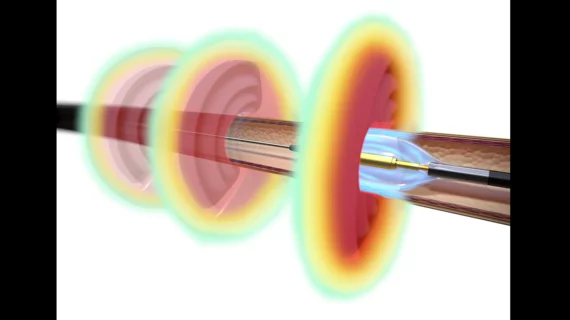
The U.S. Centers for Medicare and Medicaid Services (CMS) finalized a massive policy update Tuesday when it agreed to cover renal denervation (RDN) for all qualifying Medicare patients with uncontrolled hypertension.
The news came on the heels of TCT 2025 in San Francisco, a four-day conference that featured brand new data from Recor Medical and Medtronic, the two current market leaders in RDN technology.
Recor Medical’s Paradise Ultrasound RDN system the subject of two different trials
Two presentations at TCT 2025 focused on Recor Medical’s Paradise Ultrasound RDN system, which uses seven-second bursts of ultrasound energy for ablation and received U.S. Food and Drug Administration (FDA) approval in 2023.
First, an analysis of the Global Paradise System Registry found that the Paradise Ultrasound technology was associated with a 19.6 mm Hg reduction in office systolic blood pressure and 14.4 mm Hg reduction in home systolic blood pressure after six months. In addition, no safety events were reported.
Those findings were based on data from more than 200 real-world patients treated at nine different countries outside of the United States.
The other study, based on a pooled cohort of patients from the RADIANCE trials, found that using the Recor Medical system resulted in a 15.7 mm Hg reduction in office systolic blood pressure after 24 months. Again, no safety events were reported.
“The growing body of real-world evidence continues to demonstrate the power of the Paradise Ultrasound RDN system to meaningfully lower blood pressure in patients with uncontrolled and resistant hypertension,” Lara Barghout, Recor Medical’s president and CEO, said in a statement. “These results further strengthen the case for the Paradise Ultrasound RDN system as a safe, durable and effective treatment option and underscore the important and real impact this therapy can have on patients’ lives.”
Long-term data on Medtronic Symplicity Spyral RDN system
Yet another TCT presentation focused on Medtronic’s own Symplicity Spyral RDN system, the second RDN offering to gain FDA approval. The Symplicity Spyral RDN technology uses radiofrequency energy to ablate the patient’s nerves.
The authors of that analysis explored long-term data on more than 200 patients treated with the Symplicity Spyral system. Overall, the group was linked to a 14 mm Hg reduction in 24-hour ambulatory systolic blood pressure and 18.5 mm Hg reduction in office-based systolic blood pressure. Both figures were significant improvements over the study’s control group, which experienced reductions of 9.3 mm Hg and 7.4 mm Hg, respectively.
Authors also noted that no renal artery stenosis greater than 70% was observed after the end of the three-year window.
“These results further underscore the consistent and durable effects of the Symplicity blood pressure procedure, with the most long-term data presented and published to date,” Jason Weidman, senior vice president and president of Medtronic’s coronary and RDN business, said in a statement.

Michael has more than 19 years of experience as a professional writer and editor. He has written at length about cardiology, radiology, artificial intelligence and other key healthcare topics.