
New heart device for ‘no-option’ chest pain patients shows early potential
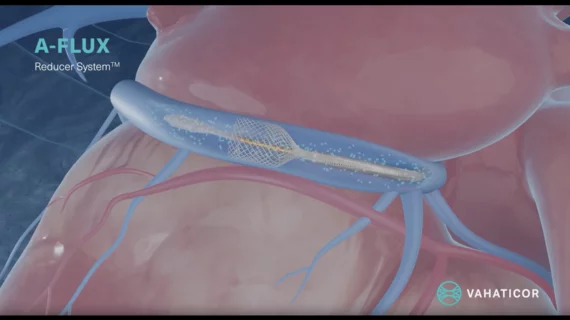
A new self-expanding, recapturable coronary sinus reducer for patients with coronary microvascular dysfunction (CMD) or obstructive epicardial coronary artery disease (CAD) is safe to use and associated with “promising” short-term outcomes, according to an early analysis published in JSCAI.[1] The improvements in symptom burden achieved with this device were maintained for six months after treatment.
The device at the heart of this study is the A-Flux Reducer System from California-based VahatiCor. It is a nitinol coronary sinus reducer designed to be a new therapy option for “no-option” chest pain patients who see no benefits from other treatments. Interventional cardiologists implant the hourglass-shaped device percutaneously into the patient’s coronary, where it increases blood flow in a way that provides more oxygen to the heart and relieves symptoms. It was designed to conform to any patient’s anatomy, according to VahatiCor, and it can be repositioned or retrieved as necessary.
The very first implant of the A-Flux Reducer System occurred in early 2024. The procedure was led by interventional cardiologists Jean-Michel Paradis, MD, and Can Manh Nguyen, MD, with the Quebec Heart and Lung Institute. Paradis is also a co-author author of this latest study.
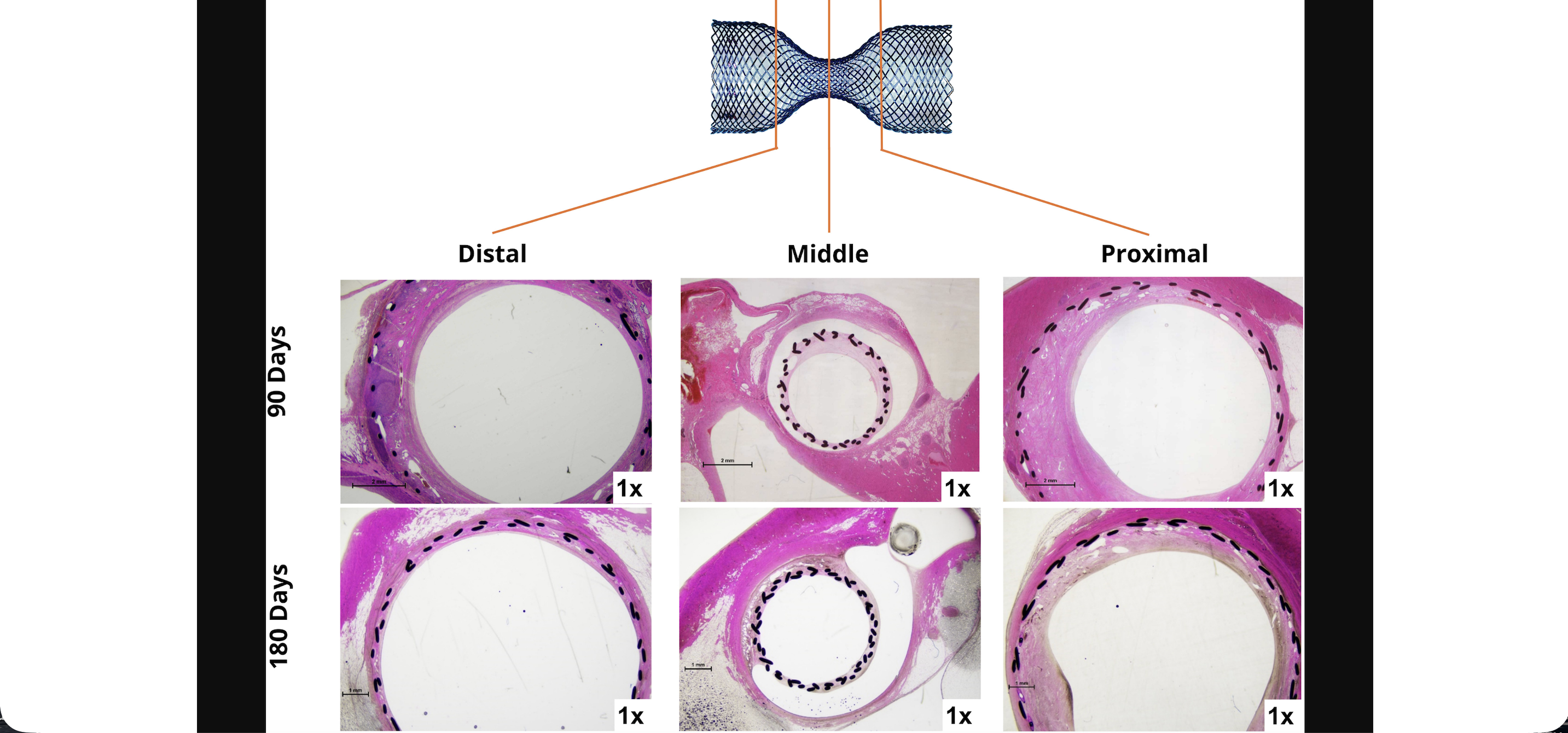
Histological evaluation of stented coronary sinus at the 3- and 6-month follow-up after A-FLUX implantation. Image and caption courtesy of JSCAI, Giannini et al.
What new data tell us about the safety and effectiveness of the A-Flux Reducer System
This research focused on 12 patients who presented with either CMD or obstructive CAD. The mean patient age was 66.8 years old, and 58% were men. The mean ejection fraction was 56%. While 75% of patients had a history of prior percutaneous coronary intervention, 50% had a history of a prior myocardial infarction.
While one procedure was not completed due to the patient’s’ challenging coronary sinus anatomy, the other 11 implants were successful. There were no procedure-related adverse events. The patients reported significant improvements in Canadian Cardiovascular Society angina class categorizations and Seattle Angina Questionnaire scores.
“In our experience, no device-related periprocedural complications have been reported thus far in both the clinical and preclinical experiences,” wrote first author Francesco Giannini, MD, an interventional cardiologist with IRCCS Ospedale Galeazzi Sant'Ambrogio in Milan, Italy. “This could be partially explained by the fact that the A-Flux delivery system’s nose cone is tapered and low profile (sub–3 mm diameter) and designed to fit within the A-Flux coronary sinus reducer, allowing secure, controlled retrieval, thus also minimizing the risk of device dislodgement.”
The group noted that additional research is already underway to learn more about this device’s long-term potential.
This analysis was not funded by VahatiCor, though the company did provide technical support to the researchers involved.
“In this clinical experience, a next-generation self-expanding coronary sinus reducer demonstrates procedural safety coupled with promising short-term clinical efficacy in persistently symptomatic patients with either obstructive epicardial CAD or nonobstructive epicardial coronaries with CMD,” the authors concluded. “The device’s safety is also supported by favorable preclinical data demonstrating good tissue healing, device endothelialization and patency without thrombosis through six months.”
Click here to read the full study in JSCAI, the flagship journal of the Society for Cardiovascular Angiography and Interventions.

Michael has more than 19 years of experience as a professional writer and editor. He has written at length about cardiology, radiology, artificial intelligence and other key healthcare topics.