
Ultrathin iron bioresorbable scaffold shows promise in first randomized trial
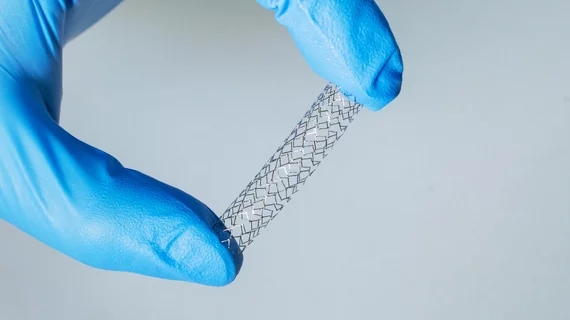
An investigational iron bioresorbable scaffold (IBS) could deliver significant value to care teams performing percutaneous coronary intervention (PCI), according to a new analysis published in JACC.[1]
The study’s authors noted that bioresorbable scaffolds have emerged in recent years as a potential alternative to metallic drug-eluting stents, which are associated with increased risks of inflammation and late stent thrombosis. It is believed that bioresorbable scaffolds can reduce the risk of late thrombosis, restore endothelial-dependent vasomotion and enable positive vessel remodeling. However, the outcomes linked to early-generation bioresorbable scaffolds have been suboptimal.
A new ultrathin IBS from Biotyx Medical could offer care teams considerable value, and a first-in-human pilot found it to be both safe and effective.[2] To learn more, researchers performed the first randomized trial to focus on the new-look device.
The multicenter analysis, IRONMAN-II, focused on more than 500 patients with coronary artery disease who underwent PCI in China from March to December 2022. Patients were randomized to be treated with the new IBS or with a contemporary metallic cobalt chromium everolimus-eluting stent (CoCr-EES) manufactured by Abbott.
Overall, at two years, the mean in-segment late lumen loss (LLL) measurements were 0.28 mm for IBS patients and 0.23 mm for CoCr-EES patients. Mean quantitative flow ratios were 0.90 for IBS patients and 0.92 for CoCr-EES patients. Meanwhile, target lesion failure (TLR) rates after two years were 7.4% for IBS patients and 5.4% for CoCr-EES patients.
Also, a patient-oriented composite endpoint that included all-cause mortality, myocardial infarction and revascularization did not identify any significant differences between the two treatment options.
Reviewing all of these data, the researchers determined that the IBS from Biotyx Medical was noninferior to the CoCr-EES. However, they also noted that more research is still necessary to learn more about the long-term impact of these investigational devices.
“Ongoing follow-up through five years will provide insight into whether fewer adverse events might accrue with the IBS after its complete bioresorption at three years compared with the permanent metallic drug-eluting stents,” wrote first author Runlin Gao, MD, an interventional cardiologist with Fuwai Hospital in China, and colleagues.
Click here to read the full study in JACC, an American College of Cardiology journal.

Michael has more than 19 years of experience as a professional writer and editor. He has written at length about cardiology, radiology, artificial intelligence and other key healthcare topics.