
Next-generation Watchman enters trial in 2026 as LAAO volume grows
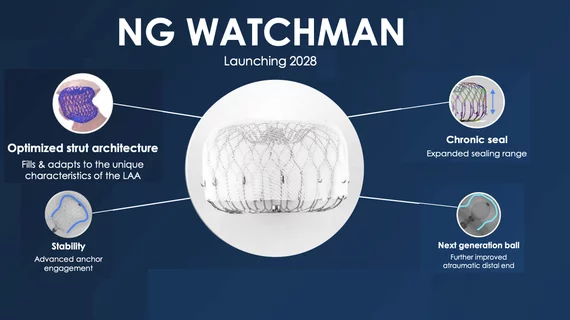
Boston Scientific announced at its Investor Day event Sept. 30 it plans to launch its fourth-generation Watchman left atrial appendage closure (LAAC) device, which will enter a pivotal U.S. trial in 2026. The company also said it expects to see a large expansion in LAAC growth over the next few years.
The next-generation Watchman device is designed to better seal off complex LAA anatomy to prevent strokes in atrial fibrillation patients. It uses an optimized architecture to fill gaps and adapt to the unique characteristics of each patient's unique appendage. It will also offer an expanded sealing range to fit more patients.
The device will be tested in the NG Watchman Investigational Device Exemption (IDE) trial planned to start in 2026, with results expected by early 2028. It will be a single arm study with a 45-day endpoint.
The Watchman is the leader in the LAAC market, with the company disclosing at the meeting more than 600,000 patients have now been implanted with the device. Angelo De Rosa, global president, Watchman, said the device leads the $2 billion LAAC market that has had sustainable growth rate of about 20% annually.
"We are working fervently to maintain and grow our leadership," De Rosa explained.
Part of the strategy to maintain that lead over competitor is with continued refinement of its device and additional clinical research that could lead to wider indication expansion.
CHAMPION AF trial could lead it large expansion for LAAC
Watchman is currently indicated for patients who can tolerate short term oral anticoagulation (OAC), but not long term anti-coagulation. But the company believes the indication could be greatly expanded due to ongoing issues with patients failing to take their medication. Data is expect data in the first half of 2026. If positive, Boston Scientific believes it would unlock a much wider patient population for LAAC.
"Left atrial appendage closure is foundation to a comprehensive AF management strategy. While novel oral anticoagulants (NOACs) are the frontline therapy for preventing strokes, they are not perfect and they have side effects. On top of that, 40% of patients are still at risk because of nonadherance," explained Brad Sutton, MD, chief medical officer, atrial fibrillation solutions, Boston Scientific. "We expect that our indication could expand upward to 20 million patients with atrial fibrillation by 2030."
Indicated patients today for LAAC amount to about 5 million. But in the trial data changes the FDA Watchman indication, that could expand the U.S. market with an additional 8 million patients. In Europe, the Middle East and Africa this would expand the patient population by another 10 million.
Additionally, De Rosa said the number of AFib patients is expected to see a big expansion over the next few years, as studies continue to show a much larger patient population and previous believed just a few years ago. New estimates put the AFib population at about 60 million patients globally. Wider AFib awareness and diagnosis will lead to more LAAC procedures.
Concomitant LAAC and ablation procedures on the rise
Sutton said the company is also working with hospitals interested expanding combination procedures with Farapulse Pulsed Field Ablation (PFA) and a concomitant LAAC procedure, which the company dubs a "FaraWatch" procedure. This is aimed at addressing the risks of stroke in one procedure, especially as hospitals are experiencing high growth in AFib procedure volumes and are looking for ways to reduce the number of procedures on the same patient and increase efficiency.
About 50% of ablation patients remain at high risk for stroke following their procedure, and about 25% of patients are now receiving Watchman at the same time as their ablation, Sutton said. He expects that number to rise to enable more patients to come off of OAC.
AI technology may enhance LAAC planning and guidance
"We believe imaging will be a critical element to further expand the therapy option. The imaging remains a critical element of a successful Watchman delivery," De Rosa said.
For this reason, he said, Boston is working on new transesophogeal echo (TEE) and 4D intracardiac echo (ICE) imaging guidance technology augmented with artificial intelligence (AI). The idea is to enhance preplanning and the over all procedure workflow efficiency. The company is partnering cardiac AI vendor Anumana to develop new generative AI imaging and visualization technologies.

Dave Fornell has covered healthcare for more than 17 years, with a focus in cardiology and radiology. Fornell is a 5-time winner of a Jesse H. Neal Award, the most prestigious editorial honors in the field of specialized journalism. The wins included best technical content, best use of social media and best COVID-19 coverage. Fornell was also a three-time Neal finalist for best range of work by a single author. He produces more than 100 editorial videos each year, most of them interviews with key opinion leaders in medicine. He also writes technical articles, covers key trends, conducts video hospital site visits, and is very involved with social media. E-mail: [email protected]