
FDA approves new device for capturing debris during TAVR
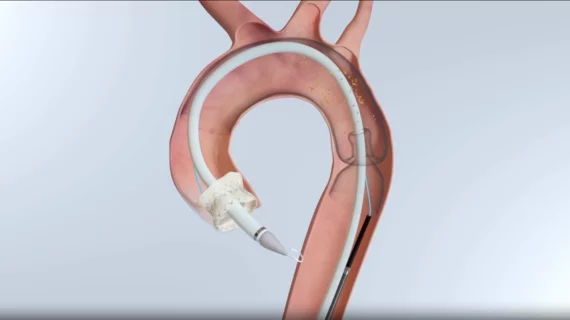
Emboline, a California-based medtech company, has received U.S. Food and Drug Administration (FDA) approval for its Emboliner Embolic Protection System. The device was built to capture and remove embolic material during transcatheter aortic valve replacement (TAVR) procedures. This is seen as a way to reduce the risk of stroke, which clinicians have been battling since TAVR was first introduced, as well as other potential complications.
“We developed the Emboliner to address important unmet needs with existing embolic protection approaches for TAVR,” Scott Russell, president and CEO of Emboline, said in a statement. “We are excited to now be able to put the Emboliner in the hands of physicians so that they can offer a more comprehensive embolic protection solution for their patients. We are grateful to the clinical investigators whose partnership and feedback helped us reach this point.”
The Emboliner device includes a self-expanding filter that covers all three cerebral vessels. The filter’s double-layer mesh captures debris without restricting blood flow in any way.
Emboline plans on beginning its commercial launch of the newly approved device by the end of 2026.
Emboliner vs. Sentinel: Recent late-breaking study compared the two devices
At ACC.26 in New Orleans, Adam Greenbaum, MD, an associate professor of medicine and co-director of the Structural Heart and Valve Center at Emory School of Medicine in Atlanta, presented late-breaking data from the ProtectH2H clinical trial that compared the Emboliner device to Boston Scientific’s Sentinel Cerebral Protection System. More than 500 TAVR patients with a mean age of 79 years old were enrolled out of the United States, Germany and Brazil. Patients were excluded if they had experienced a stroke in the previous six months.
Overall, the head-to-head study showed that the Emboliner device was noninferior to the Sentinel in terms of a composite primary endpoint of all-cause death, stroke or kidney failure within 30 days of TAVR. However, the Emboliner captured significantly more debris and was linked to an improved technical success rate.
After Greenbaum presented those data at ACC.26, Michael Young, MD, an interventional cardiologist with Dartmouth Hitchcock Medical Center, described eliminating the risk of stroke after TAVR as the “holy grail” of interventional cardiology.
Clinical studies focused on embolic protection devices, primarily those studying the Sentinel system, has been associated with mixed results up to this point. Two studies, BHF PROTECT-TAVI and PROTECTED TAVR, failed to link cerebral protection with consistent across-the-board benefits in terms of risk reduction, though there were signs—in PROTECTED TAVR especially—that embolic protection may limit the risk of patients experiencing a major/disabling stroke. Some cardiologists swear by these devices, but others have said they are waiting on better data showing that they can improve patient outcomes.

Michael has more than 19 years of experience as a professional writer and editor. He has written at length about cardiology, radiology, artificial intelligence and other key healthcare topics.