
SCAI's position on TAVR changes evolved after member survey
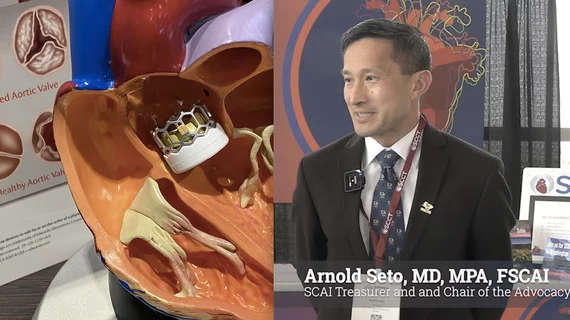
The Society for Cardiovascular Angiography and Interventions (SCAI) adjusted its advocacy position on transcatheter aortic valve replacement (TAVR) operator requirements after a member survey revealed divided opinions on whether the procedure should require both an interventional cardiologist and a cardiac surgeon.
Arnold Seto, MD, cath lab director for the VA Long Beach Healthcare System, professor of medicine at Charles Drew University, said the results helped shape the organization's response to the Centers for Medicare and Medicaid Services (CMS) review of its national coverage determination (NCD) for TAVR. Seto, who is SCAI's treasurer and the chair of its advocacy committee, said this was the biggest advocacy effort SCAI was involved with over the summer.
The SCAI survey found that 38% of 267 respondents supported allowing a single operator to perform TAVR, while 41% favored flexibility to use two operators. This potentially could include two interventional cardiologists or two cardiac surgeons. Only 21% supported maintaining the existing model requiring one interventional cardiologist and one cardiac surgeon.
“It would be inappropriate for us to be opposed to a single operator requirement ... if a significant proportion of our members were in favor of it,” Seto said. "I think it's very enlightening to all of us that there was a diversity of opinion and SCAI really had to accommodate and adjust its position.
He said SCAI was asked why it was not offering more advocacy in support of an interventional cardiologist working as a single operator TAVR procedures when the evidence shows it is safe. TAVR has evolved like percutaneous coronary intervention (PCI) did; years ago, cath labs were required to have surgical backup for all PCI procedures, but safety improved to the point where that requirement was eliminated. TAVR now has such a strong safety profile that one could argue something similar could occur now when it comes to that procedure.
Balancing TAVR procedural flexibility and patient safety
The policy debate emerged after Edwards Lifesciences requested that CMS remove coverage with evidence development (CED) requirements for TAVR, citing years of evidence supporting the procedure for patients with severe symptomatic aortic stenosis. The request prompted CMS to reconsider existing coverage restrictions and solicit stakeholder comments.
Under the existing policy described by Seto, a cardiac surgeon and an interventional cardiologist must be present during the procedure. But he said many interventional cardiologists increasingly view TAVR as a single-operator procedure, given improvements in technique and the declining need for emergency surgical conversion. Seto said surgical conversion rates have now fallen below 1%.
However, he cautioned against interpreting the low conversion rate as eliminating the need for surgical expertise. Although rare, complications requiring emergency surgery can be catastrophic, including aortic annular rupture.
“If it's a 1% conversion rate, that 1% is a lot worse than a PCI complication,” he said.
SCAI therefore sought a balanced position that would recognize the growing case for single-operator TAVR while preserving institutional flexibility to use two operators when patient needs or local practice warranted it.
CMS changes may reshape structural heart programs
Seto said CMS' proposed rule reflected several elements of the flexibility SCAI had wanted. SCAI reviewed that proposal and then worked with the American College of Cardiology and Society of Thoracic Surgeons on a letter highlighting how the groups felt about the potential changes.
One thing SCAI advocated against was reimbursement policies that could favor single-operator procedures at the expense of institutions choosing a two-operator approach. If a hospital determines that two operators are necessary, Seto said, that approach should remain eligible for payment without additional barriers.
In September, after many months of consideration, CMS finalized changes to the TAVR NCD. Click here to read more about the agency's final decision.
For SCAI, this process illustrated how member feedback can shape advocacy when procedural innovation and safety concerns point in different directions. The group may have other TAVR changes to comment on in 2027, because CMS recently announced it is considering even more changes to its current TAVR NCD.

Dave Fornell has covered healthcare for more than 17 years, with a focus in cardiology and radiology. Fornell is a 5-time winner of a Jesse H. Neal Award, the most prestigious editorial honors in the field of specialized journalism. The wins included best technical content, best use of social media and best COVID-19 coverage. Fornell was also a three-time Neal finalist for best range of work by a single author. He produces more than 100 editorial videos each year, most of them interviews with key opinion leaders in medicine. He also writes technical articles, covers key trends, conducts video hospital site visits, and is very involved with social media. E-mail: [email protected]