
FDA clears first dedicated tricuspid surgical valve
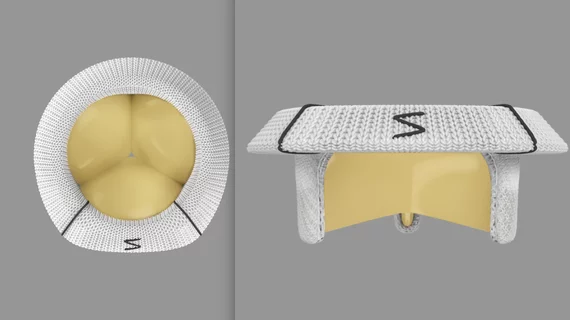
The U.S. Food and Drug Administration (FDA) has cleared the Edwards Lifesciences Triformis Resilia, the first surgical tricuspid valve replacement designed specifically for patients with tricuspid valve disease.
The device uses a tricuspid-specific design, with a flat profile sewing ring that mimics the tricuspid annulus and a shape designed for optimal seating in this valve position. It also has clear commissure and septal region markers in the sewing ring to help with orientation and positioning. The company said it is identical to its Mitris Resilia mitral valve.
The device is indicated for the replacement of native or prosthetic tricuspid heart valves. It is available in sizes 25, 27, 29, 31 and 33 mm.
The device also uses Edwards’ Resilia tissue technology, a bovine pericardial tissue that undergoes a proprietary treatment to resist calcification by blocking calcium-attracting chemicals and allows for dry storage. Resilia bioprosthetic valve technology is already used with good results across Edwards’ surgical and TAVR valve portfolios, and is now offered for the tricuspid valve.
New 10-year results from the COMMENCE surgical aortic valve trial highlight the long-term durability and sustained performance of the Resilia tissue surgical valve. Data presented at the 2026 American Association for Thoracic Surgery (AATS) annual meeting show a 97.9% freedom from structural valve deterioration (SVD), 97.8% freedom from reoperation due to SVD, 98.6% freedom from non-structural valve dysfunction (other than paravalvular leak) and sustained hemodynamic performance. The valve technology also has been shown in studies to reduce pannus, an abnormal overgrowth of fibrous tissue.
The valve was cleared by the FDA without a pivotal trial. Edwards said the FDA approval for the new valve was supported by a retrospective analysis of real-world, off-label use data captured in electronic health records (EHRs) from use of mitral valves that did undergo FDA premarket approval (PMA) trials and share the same core design and technology as the new valve. The data submitted to the FDA contained 204 patients who underwent off-label tricuspid valve replacement (TVR) using the Magna Mitral, Magna Mitral Ease, or Mitris Resilia mitral valves between January 2016 and August 30, 2024.
The company said this established a reasonable assurance of the safety and effectiveness of the valve in patients receiving surgical tricuspid valve replacement (TVR).
“The real-world evidence demonstrated that the Triformis Resilia Tricuspid Valve is effective in replacing diseased and malfunctioning tricuspid valves in a representative patient population, as evidenced by reasonable incidence rates of all-cause mortality and heart failure hospitalization. Further, the real-world evidence demonstrated that the use of the valve did not raise any major safety concerns,” Edwards said in a statement to Cardiovascular Business.
Historically, surgery for isolated tricuspid regurgitation was rarely performed because of perceptions of high mortality from early studies years ago. The high mortality in these studies made surgeons less likely to intervene, which led to the tricuspid valve often being referred to as the “forgotten valve.” However, many experts say the poor outcomes in historic literature are likely due to treating patients who were in end-stage, right-sided heart failure, and treating patients earlier can have better results.
This idea is supported by a newer analysis of Society of Thoracic Surgery (STS) registry outcomes that show the risk of intervening on the tricuspid valve is lower than previously observed, at 5.6% overall predicted risk of operative mortality. Edwards Lifesciences said this data provides a new benchmark for current and future isolated tricuspid valve interventions.

Dave Fornell has covered healthcare for more than 17 years, with a focus in cardiology and radiology. Fornell is a 5-time winner of a Jesse H. Neal Award, the most prestigious editorial honors in the field of specialized journalism. The wins included best technical content, best use of social media and best COVID-19 coverage. Fornell was also a three-time Neal finalist for best range of work by a single author. He produces more than 100 editorial videos each year, most of them interviews with key opinion leaders in medicine. He also writes technical articles, covers key trends, conducts video hospital site visits, and is very involved with social media. E-mail: [email protected]