
FDA clears next-gen peripheral thrombectomy device
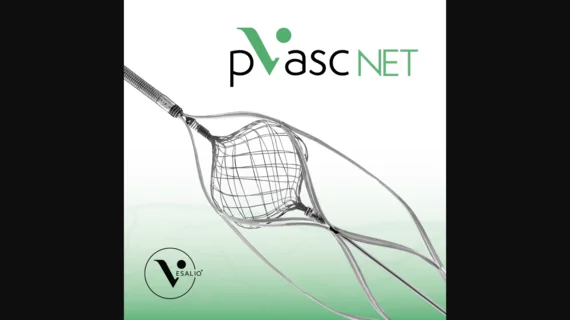
Vesalio, a Dallas-based medtech company, has secured U.S. Food and Drug Administration (FDA) clearance for a next-gen peripheral mechanical thrombectomy device with a dual-layer distal filter.
The pVasc NET is a self-expanding nitinol device built for the minimally-invasive removal of emboli and thrombi from a patient’s peripheral blood vessels. Like the company’s previous pVasc devices, it features Vesalio’s proprietary Drop Zone architecture that captures and extracts emboli. One new feature with the pVasc Net is a fine-pore, dual-layer filter integrated in the distal part of the device.
“Peripheral thrombectomy can be particularly challenging in small or diseased vessels, where maintaining control and preserving available runoff are important considerations,” Gustavo Prado, PhD, Vesalio’s vice president of development and regulatory, said in a statement. “pVasc NET builds on the proven design principles of our Drop Zone platform by incorporating an integrated filter designed to retain clot fragments during retrieval, while maintaining the low-profile delivery system and straightforward workflow physicians value.”
“This FDA clearance represents an important expansion of our peripheral vascular portfolio and brings a differentiated technology to physicians treating thromboembolic disease across challenging anatomy,” added Steve Rybka, Vesalio’s CEO. “We believe pVasc NET will provide physicians with an important new tool for peripheral thrombectomy.”
News follows another importance clearance in 2025
In December 2025, the FDA cleared Vesalio’s enVast device for coronary thrombectomy procedures.
“enVast is the first coronary-specific retriever designed with a stent-based clot capture architecture enhanced by our proprietary Drop Zone technology,” Rybka said at the time. “Clinical experience internationally has consistently demonstrated its safety and effectiveness in managing complex LTB situations. We’re excited to now make this impactful solution available to U.S. interventional cardiologists and their patients.”

Michael has more than 19 years of experience as a professional writer and editor. He has written at length about cardiology, radiology, artificial intelligence and other key healthcare topics.