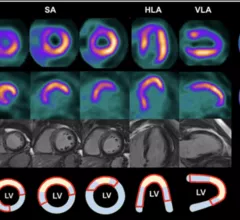
Positron emission tomography/computed tomography is a hybrid nuclear medicine imaging technique that helps radiologists spot abnormal metabolic activity. PET/CT is commonly used to diagnose cancers, heart diseases and certain brain disorders, among other conditions.
Which imaging modality is better for evaluating heart patients, PET or SPECT? After years of discussions and debates, the American Society of Nuclear Cardiology is now ready to point to PET as the No. 1 choice. “There are no clinical scenarios or patient subgroups where cardiac PET with myocardial blood flow should be excluded," the group wrote.
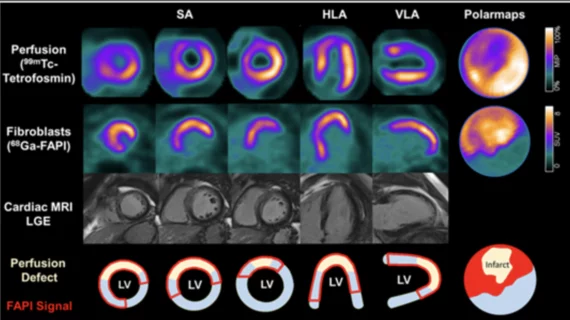
More and more imaging researchers are starting to examine the potential of using fibroblast activation protein inhibitors (FAPI) to manage patients with suspected cardiovascular disease.
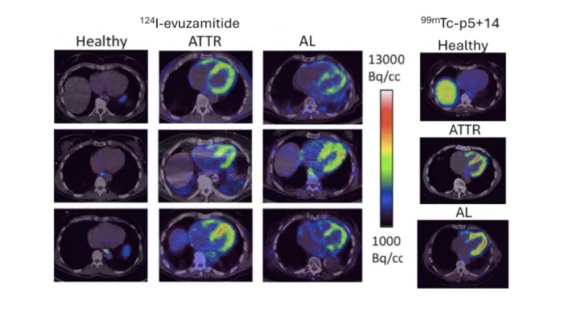
Bayer is acquiring two cardiac amyloidosis radiotracers from Attralus, one for PET and one for SPECT. The SPECT tracer is also a theranostic agent to both image and treat amyloidosis.
Sarah-Jane James, imaging market analyst for Signify Research, discusses key trends in the specialty that she saw at the Radiological Society of North America's annual meeting.
The Society of Nuclear Medicine and Molecular Imaging has chosen its 2022 Image of the Year, and it’s one that is sure to interest anyone in the field of cardiac imaging.
The American Society of Nuclear Cardiology recently met with the Louisville, Kentucky, insurer, which shared an openness to reviewing a recent coverage determination.
Multiple nuclear medicine and cardiology groups are working to oppose potential cuts to myocardial PET scans that were made possible by the CMS 2020 Medicare Physician Fee Schedule (MPFS) proposed rule, according to a joint statement.
When CMS released the 2020 Medicare Physician Fee Schedule (MPFS) proposed rule, it included revisions that could lead to technical component payment reductions of up to 80% for certain services related to myocardial PET scans.
The Society of Nuclear Medicine and Molecular Imaging (SNMMI) and the American Society of Nuclear Cardiology (ASNC) submitted a letter to BlueCross BlueShield (BCBS) of Tennessee urging an expansion of cardiac PET coverage.
PET with 11C-PIB provides a noninvasive method for visualizing amyloid deposits in the heart, according to a study published in the February issue of the Journal of Nuclear Medicine. The researchers suggest that 11C-PIB eventually may be used in the clinical setting as both a diagnostic tool and a treatment follow-up method.