
FDA approves smaller leadless pacemaker from Abbott
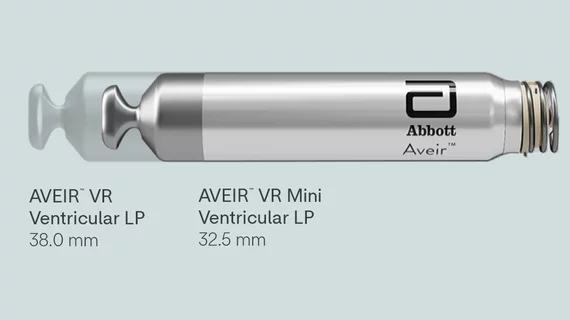
The U.S. Food and Drug Administration (FDA) has approved Abbott's Aveir VR Mini Ventricular leadless pacemaker (LP). The new device is 14% shorter than the Aveir VR Mini Ventricular, shortened from 38 mm to 32.5 mm. According to Abbott, this offers an additional option to patients who require a lower-profile device, potentially expanding the number of patients who can be treated with a leadless pacing system. This approval also expands implant options in the smaller space of the right ventricle.
Abbott sees the Aveir AR2 Atrial LP and Aveir VR Mini Ventricular LP as the next step in the evolution of its Aveir DR LP, which is the world’s only dual-chamber leadless pacemaker system. These systems use a unique implant-to-implant, in-body communication between two leadless pacemakers implanted directly inside each ventricle to coordinate synchronous beating of the heart.
Leadless pacing was previously limited to patients who only needed single-ventricle pacing. With so many patients needing biventricular pacing, these systems have helped expand care to a larger percentage of patients.
“Abbott is advancing leadless pacing and expanding options for physicians and patients,” Randel Woodgrift, senior vice president of Abbott’s cardiac rhythm management business, told Cardiovascular Business. “Together, Aveir AR2 and Aveir VR Mini represent the next generation of the world’s only dual-chamber leadless pacing system, giving physicians a highly optimized atrial and ventricular pairing that expands the reach of this technology to a broader patient population.”

Dave Fornell has covered healthcare for more than 17 years, with a focus in cardiology and radiology. Fornell is a 5-time winner of a Jesse H. Neal Award, the most prestigious editorial honors in the field of specialized journalism. The wins included best technical content, best use of social media and best COVID-19 coverage. Fornell was also a three-time Neal finalist for best range of work by a single author. He produces more than 100 editorial videos each year, most of them interviews with key opinion leaders in medicine. He also writes technical articles, covers key trends, conducts video hospital site visits, and is very involved with social media. E-mail: [email protected]