
Targeted lead placement fails to improve outcomes for heart failure patients undergoing CRT
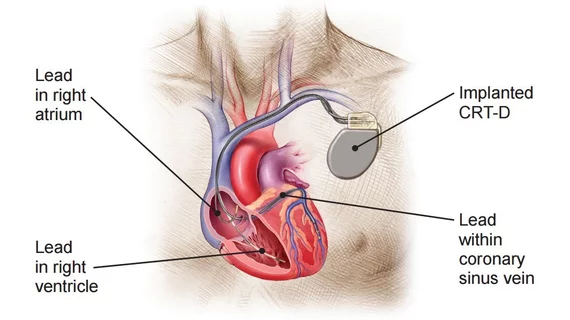
For years now, clinicians have believed about one-third of heart failure patients do not respond to cardiac resynchronization therapy (CRT) due to poor lead placement. According to a new late-breaking data presented at ESC Congress 2026, however, that may not be true.
CRT is seen as a revolutionary treatment for heart failure patients with reduced left ventricular ejection fraction (HFrEF) and a wide QRS ECG. A greater effort has been made in recent years to better target CRT leads using His-bundle pacing and left bundle branch area pacing to overcome conduction abnormalities such as left bundle branch block (LBBB). Until now, though, there have not been any large, randomized studies to show the actual level of efficacy using this technique.
The DANISH-CRT trial compared targeted placement of the left ventricular pacing lead with standard placement. Investigators were surprised to find there was no difference in death or first heart failure hospitalization between the two techniques.
“Our findings do not support routine electrical mapping to target left ventricular lead placement in contemporary CRT practice,” Professor Cosedis Nielsen, PhD, department chair of cardiology with Aarhus University Hospital, said in a statement, “We will continue to analyse data from the DANISH-CRT trial to investigate which patient subgroups benefitted most from CRT.”
This was an investigator-initiated, double-blind trial conducted in all five Danish university centers that perform CRT device implants. The study included 1,000 patients who had heart failure and LBBB on guideline-directed medication and were referred for biventricular pacing. Patients were randomized to either left ventricular lead placement targeted to the site of latest electrical activation within the coronary sinus branches or standard lead placement in the posterolateral, non-apical coronary sinus.
After a median of 45.8 months of follow-up, there was no significant difference in the primary endpoint of death or first unplanned hospitalization for heart failure between the two study arms. That endpoint was identified in 27.9% of targeted lead placement patients vs. 25.5% of standard lead placement patients. Consistently similar findings were observed across secondary endpoints such as structural changes to the left ventricle, quality of life, functional status and physical capacity, as well as in subgroup analyses of the primary endpoint. Also, numerically, there were more lead-related complications observed in the targeted lead placement group.

Dave Fornell has covered healthcare for more than 17 years, with a focus in cardiology and radiology. Fornell is a 5-time winner of a Jesse H. Neal Award, the most prestigious editorial honors in the field of specialized journalism. The wins included best technical content, best use of social media and best COVID-19 coverage. Fornell was also a three-time Neal finalist for best range of work by a single author. He produces more than 100 editorial videos each year, most of them interviews with key opinion leaders in medicine. He also writes technical articles, covers key trends, conducts video hospital site visits, and is very involved with social media. E-mail: [email protected]