
Surgeon hails new CABG technology as a 'technical breakthrough'
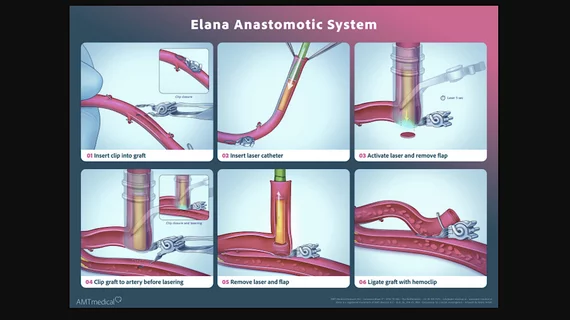
A first-of-its-kind system replaces hand-sewing coronary bypass graft connections with a sutureless, laser-assisted technique that enables the coronary artery to remain open during surgery. AMT Medical reported one-year results for its ELANA Anastomotic System in The Journal of Thoracic and Cardiovascular Surgery.[1]
The technology was designed to support a new generation of coronary artery bypass grafting (CABG) procedures and allow a wider adoption of minimally invasive and robotic CABG approaches. It helps greatly simplify and increase efficiency during the creation of an anastomosis and attaching the bypass graft vessel.
“For the first time, a rigorous prospective trial shows that the most challenging step of a bypass operation can be performed without sutures on a beating heart, and without ever interrupting blood flow to the patient’s coronary artery," Bart P. van Putte, MD, PhD, principal investigator of SAFE-CAB II and a surgeon with St. Antonius Hospital in The Netherlands, explained in a statement. "That is genuinely new. It is the technical breakthrough the field has been waiting for to make modern, less invasive bypass surgery available to many more patients than today.”
Distal anastomoses are almost exclusively hand-sewn as a current standard of care, limiting the widespread implementation of less invasive approaches. This study looked at the ability of the ELANA device to more easily construct distal anastomoses in CABG. The single-center, single-arm, prospective trial included 71 patients (89% male, average age 71) treated between June 2023 and August 2024. The left internal thoracic artery (LITA) to left anterior descending (LAD) anastomosis was constructed using the ELANA device, with additional hand-sewn anastomoses if required.
The primary outcome was device-related major adverse cardiac events (MACEs) after 1 year. Secondary outcomes included six-month LITA patency assessed by coronary angiography defined by FitzGibbon (FG) criteria and the one-year overall MACE rate.
The one-year device-related MACE rate was 2.9%, and the overall MACE rate was 8.7%. Six-month LITA patency was 92.5%, with FG criteria A 40.6%, B 51.6%, and O 7.8%. Intravascular ultrasound (IVUS) was performed in six patients with FG criteria B; it revealed no significant stenosis.
Overall, while the trial demonstrated the safety and effectiveness of the ELANA device, long-term follow-up is still needed to confirm the research team's findings. These same patients will be followed for another year.
Reference:

Dave Fornell has covered healthcare for more than 17 years, with a focus in cardiology and radiology. Fornell is a 5-time winner of a Jesse H. Neal Award, the most prestigious editorial honors in the field of specialized journalism. The wins included best technical content, best use of social media and best COVID-19 coverage. Fornell was also a three-time Neal finalist for best range of work by a single author. He produces more than 100 editorial videos each year, most of them interviews with key opinion leaders in medicine. He also writes technical articles, covers key trends, conducts video hospital site visits, and is very involved with social media. E-mail: [email protected]