
Medicare now covers TriClip procedures for patients with symptomatic tricuspid regurgitation
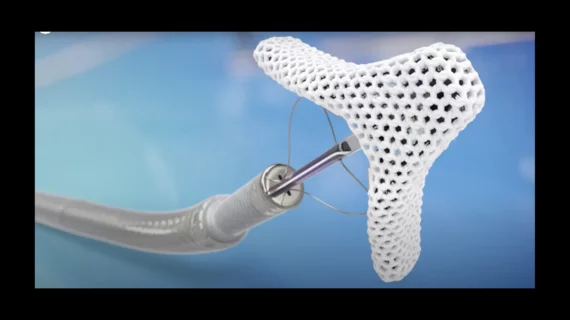
The U.S. Centers for Medicare & Medicaid Services (CMS) has finalized a new national coverage determination (NCD) for tricuspid transcatheter edge-to-edge repair (T-TEER) in patients with symptomatic tricuspid regurgitation (TR). This confirms that Medicare will now cover T-TEER, sometimes known as transcatheter tricuspid valve repair, on a national level when performed with any U.S. Food and Drug Administration (FDA)-approved device.
The TriClip system from Abbott is presently the only device that has been approved by the FDA for performing T-TEER. TriClip is delivered through a vein in the patient’s leg, repairing the tricuspid valve by clipping together the valve leaflets using the same technology found in Abbott’s popular MitraClip device.
“This CMS decision offers new hope to patients with symptomatic TR by expanding access to the minimally invasive technology of Abbott’s TriClip G5 system," Sandra Lesenfants, senior vice president of Abbott's structural heart business, told Cardiovascular Business. "We’re proud to deliver a treatment option that can significantly improve quality of life for those with limited alternatives, and help people get back to living life on their terms.”
CMS made the decision after Abbott formally requested the agency consider a NCD for T-TEER. Officials reviewed real-world data from the TRICARE clinical trial and requested industry feedback before making its final decision.
CMS emphasized that patients are only eligible to have a T-TEER procedure covered if they present with symptomatic TR that is not sufficiently reduced by optimal medical therapy. In addition, the patient must be under the care of a full heart team, including a cardiac surgeon, interventional cardiologist, heart failure specialist and an interventional echocardiographer.
“All the specialists listed above must have experience in the care and treatment of TR,” the agency said.
Click here to read the full CMS decision memo.
Progress continues for tricuspid valve care
The tricuspid valve was once seen as being somewhat forgotten compared to the aortic and mitral valves. In recent years, however, treatment options for patients suffering from symptomatic TR have started to emerge.
TriClip was the second medical device approved by the FDA for the treatment of TR. The first was the Evoque transcatheter tricuspid valve replacement (TTVR) system from Edwards Lifesciences, which gained approval in February 2024. The Evoque device completely takes the place of the patient’s tricuspid valve, as opposed to repairing it.
In addition to these two devices, many other treatment options for T-TEER and TTVR are now in development.
“There are more devices in clinical trials for the tricuspid valve at this time than we could possibly discuss,” Andrew Rassi, MD, a cardiologist with Kaiser Permanente’s San Francisco Medical Center, told Cardiovascular Business in a 2024 interview. “Some are farther along than others and only a few have had successful implants in humans to date. The number of devices being studied speaks to the unmet clinical need that will only be partially answered with the two FDA-approved devices.”
Medical societies urged Medicare to pay for T-TEER
In late 2024, the American Association for Thoracic Surgery, American College of Cardiology, American Society of Echocardiography, Heart Rhythm Society, Society for Cardiovascular Angiography and Interventions and Society of Thoracic Surgeons sent a 13-page letter to CMS outlining why T-TEER should be reimbursed. The president of each society signed the letter, calling for the development of a new registry that could monitor patients treated with T-TEER for years to come.

Michael has more than 19 years of experience as a professional writer and editor. He has written at length about cardiology, radiology, artificial intelligence and other key healthcare topics.