
PARTNER 3 update: TAVR still comparable to SAVR in low-risk patients after 7 years
Transcatheter aortic valve replacement (TAVR) and surgical aortic valve replacement (SAVR) are associated with comparable seven-year outcomes when low-risk patients present with severe aortic stenosis, according to new data presented at TCT 2025 in San Francisco. The findings were simultaneously published in The New England Journal of Medicine.[1]
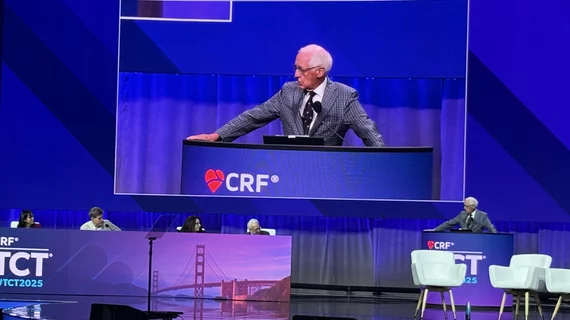
This represents the latest update from the PARTNER 3 trial. Co-author Michael J. Mack, MD, medical director of cardiovascular surgery at Baylor Scott & White Health, presented the findings in front of a packed crowd during a late-breaking clinical trial session at TCT.
PARTNER 3 trial has been one of the most closely watched clinical trials in cardiology for many years now. The study randomized 1,000 low-risk patients to undergo treatment with TAVR or SAVR. TAVR patients received a Sapien 3 valve from Edwards Lifesciences. SAVR patients received a surgical bioprosthetic valve.
Seven-year follow-up data were available for nearly 90% of patients from PARTNER 3. Overall, the study’s primary endpoint—a composite of all-cause death, stroke and rehospitalization—was seen in 34.6% of TAVR patients and 37.2% of SAVR patients. This is consistent with the five-year update, where the primary endpoint occurred in 22.7% of TAVR patients and 27.3% of SAVR patients. This is not a significantly significant difference, highlighting how similar the two treatment options appear to be for patients after seven years.
The study’s second primary endpoint was a hierarchical composite of death, disabling stroke, nondisabling stroke and the number of rehospitalization days related to the valve replacement procedure, the actual valve or heart failure complications. This was calculated using the win ratio method, and it once again showed that there were no significant differences between these treatments.
Looking closer at the seven-year outcomes data, all-cause death was 19.5% after TAVR and 16.8% after SAVR. The stroke rates were 8.5% for TAVR and 8.1% for SAVR. Aortic valve reintervention rates were 6.7% for TAVR and 6% for SAVR.
Rehospitalization, meanwhile, occurred in 20.6% of TAVR patients and 23.5% of SAVR patients. After one year, the rehospitalization rate was significantly higher for surgery (11.5%) than it was for TAVR (7.3%), but those numbers are getting closer to one another as the years go by.
Valve hemodynamics, Mack added, are “virtually the same” for these two groups. The mean aortic-valve gradients were 13.1 mm Hg after TAVR and 12.1 mm Hg after SAVR. In addition, quality of life, as defined by mean Kansas City Cardiomyopathy Questionnaire summary scores, and valve durability were comparable between the two treatment options.
“Among low-risk patients with symptomatic severe aortic stenosis treated with a Sapien 3 TAVR valve or surgery over seven years, both TAVR and surgery were associated with similar clinical event rates and no significant differences in the two primary endpoints,” Mack concluded.
Valve function and durability, he added, were “excellent and similar” for both groups.
Click here to read the full analysis in The New England Journal of Medicine. A 10-year follow-up to PARTNER 3 will be the next major update on this research.
An important long-term update
After Mack presented his team’s findings, he received a round of applause. Stefan Blankenberg, MD, medical director of University Heart & Vascular Center in Hamburg, then took the stage for a quick commentary.
“It is particularly important, if we want to trust a medical strategy, that we confirm the sustainability and durability of our medical procedures,” he said. “This has now been done, more or less, with this seven-year follow-up.”
Blankenberg highlighted the importance of following these patients with echocardiography and praised Mack et al. for paying close attention to valve hemodynamics and other key details.
Michael J. Reardon, MD, a cardiothoracic surgeon with Houston Methodist, also spoke up to sing the praises of Mack and his team. Reardon is one of the authors behind the Evolut Low Risk trial, a study similar to PARTNER 3 that focuses on Medtronic’s Evolut TAVR valves.
“I’ve been following in the footsteps of Michael Mack and Marty Leon for well over a decade,” he said. “We’ve all seen that TAVR can lower mortality and lower stroke with a faster recovery—the question has always been, if we move to these low-risk patients, will the clinical events hold up and will these valves last? Michael, you’ve done such a great job showing that we have stable clinical outcomes.”
Edwards Lifesciences, the sponsor of PARTNER 3, celebrated the seven-year data in a prepared statement.
“Insights from the PARTNER Trial series are foundational to TAVR, inspiring confidence in the procedure, advancing the therapy and fueling structural heart innovation,” said Dan Lippis, the company’s corporate vice president of TAVR technologies. “These latest findings reinforce the undeniable early benefits of TAVR and validate its long-term durability, matching surgery in key outcomes.
Surgeon shares concerns
While the panelists at TCT were largely enthusiastic about these seven-year outcomes, some in the field of cardiothoracic surgery feel that the industry-sponsored trial has its fair share of issues.
Vinay Badhwar, MD, executive chair of the WVU Heart and Vascular Institute and chair of the WVU School of Medicine’s department of cardiovascular and thoracic surgery, sat down with Cardiovascular Business at TCT to share his perspective.
“We know that patients of high surgical risk or of older age have excellent outcomes with TAVR,” Badhwar said. “Data presented and published today indeed show the encouraging durability of TAVR at 7 years. But, when interpreting these very valuable randomized data for patients of lower risk who require aortic valve replacement, some concerns remain. First, PARTNER 3 late patient withdrawals and the need to use vital status sweep may have introduced bias. Second, we see many similarities of TAVR and SAVR, but the attenuation of outcomes over time raises more questions. If we focus on the long-term hard endpoints of death and stroke that patients really care about, instead of composite outcome including early 30-day rehospitalization, we see that SAVR appears to be better than TAVR.”
He added that, at the end of the day, he just wants care teams to do the right thing for each patient. That may be TAVR at times, and it may be SAVR at times.
“I am a huge fan of structural interventions and support TAVR as an outstanding and safe option,” Badhwar said. “However, PARTNER 3 appears directionally congruent with other evidence for low-risk and younger patients … while TAVR has clear benefits, SAVR may still be a valuable first-line approach for the long-term outcomes for our low-risk patients who have preoperatively predicted long-term survival.”

Michael has more than 19 years of experience as a professional writer and editor. He has written at length about cardiology, radiology, artificial intelligence and other key healthcare topics.