
Open-source AI model delivers accurate echocardiography assessments
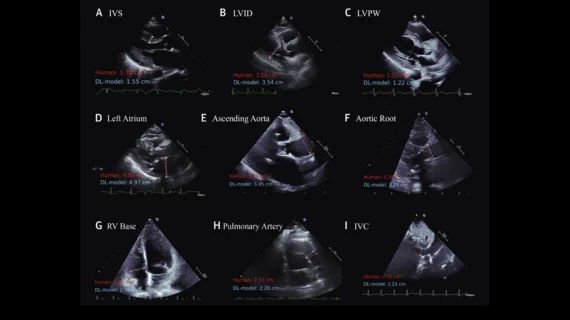
Cardiologists have developed an open-source artificial intelligence (AI) model capable of accurately evaluating a long list of measurements on echocardiography results. The group detailed the development and validation of that model in the Journal of the American College of Cardiology.[1]
“Echocardiography, the most common and readily available modality of cardiac imaging, enables frequent and rapid evaluation and surveillance of disease,” wrote corresponding author David Ouyang, MD, a cardiologist with Kaiser Permanente Santa Clara Medical Center and adjunct assistant professor at the Smidt Heart Institute at Cedars-Sinai, and colleagues. “However, echocardiographic measurements require detailed manual measurements and even expert evaluation has considerable variability. Given the large number of relevant and important echocardiographic parameters, accurate echocardiographic measurement requires a highly time-consuming effort and places a significant burden on the clinical practice of echocardiography.”
Advanced AI models have already started to make a significant impact in echocardiography, the group noted, but a majority of these have not been open-source algorithms. Ouyang et al. aimed to develop and validate their own open-source deep learning model capable of the automated measurement of 18 different measurements regularly used in echocardiography. These measurements included left ventricular internal diameter, right ventricular basal diameter, ascending aorta diameter, inferior vena cava and many more.
To develop their model, the group used data from more than 150,000 transthoracic echocardiography (TTE) studies performed at Cedars-Sinai Medical Center from 2011 to 2023. External validation focused on data from more than 1,000 studies performed at Stanford Healthcare from 2013 to 2018. In addition, “to assess the end-to-end processing for full TTE studies,” researchers used more than 2,000 CSMC studies as a temporal split validation data set.
Overall, the authors found that their AI model—called EchoNet-Measurements—achieved significant accuracy “across both linear and Doppler measurements.” While the data was only trained on data from one medical center, Ouyang and colleagues highlighted the fact that they used the “largest data set yet of sonographer annotations” to bring Echo-Net Measurements to life.
“In multiple prior works both within medicine and outside, the scale of training data has a strong impact on downstream model performance,” they wrote.
The group also emphasized that making their AI model available to the public “enables the creation of clinical data sets, supports reproducible clinical research and clinical deployments, and allows for the integration of EchoNet-Measurements models into multitasking AI systems for echocardiographic interpretation.”
Click here to read the full analysis.

Michael has more than 19 years of experience as a professional writer and editor. He has written at length about cardiology, radiology, artificial intelligence and other key healthcare topics.