
Imaging evaluations and PCI planning: Heartflow announces ‘tremendous progress’ for AI portfolio
Heartflow has announced a series of updates, including fresh data being presented at ACC.26 in New Orleans and the start of a new registry.
“These milestones reflect tremendous progress toward Heartflow's goal of transforming coronary artery disease from the world’s leading cause of death into a condition that can be detected early, diagnosed accurately, and managed for life,” Campbell Rogers, MD, chief medical officer at Heartflow, said in a statement.
Heartflow Plaque Analysis to be featured in multiple ACC.26 presentations
Heartflow’s Plaque Analysis software will be the focus of three separate presentations during ACC.26, the American College of Cardiology’s upcoming conference in New Orleans. Plaque Analysis delivers artificial intelligence (AI)-enabled coronary CT angiography (CCTA) evaluations of patients with suspected coronary artery disease (CAD).
- AI-Based Coronary Plaque Analysis and Adverse Cardiovascular Events: The Mass General Brigham CCTA Registry – Poster 1082-09, March 29, 10:06 a.m.
This study, based on real-world data from more than 15,000 patients, confirmed Plaque Analysis can predict a patient’s risk of experiencing a major adverse cardiovascular event (MACE).
- Comparative Effectiveness of Coronary Computed Tomographic Angiography With or Without AI-Plaque Analysis and Stress Testing on Lipid Lowering After One Year: A Primary Analysis of the DECIDE Registry – Poster 1469-058, March 29, 12:30 p.m.
This study, based on data from nearly 3,800 patients, confirmed that care guided by Plaque Analysis provided more value than more traditional stress-test-guided care.
- Budget Impact Analysis of AI-Guided Coronary Plaque Analysis vs. Usual Care from a US Payer Perspective – Poster 1468-019, March 29, 12:30 p.m.
This study linked the use of Plaque Analysis with approximately $140 million in savings over a two-year period.
First patient enrolled in new registry
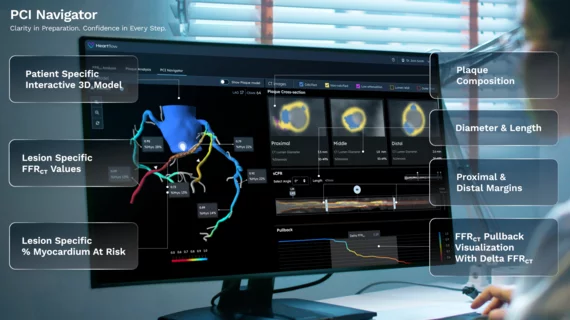
Heartflow also announced that the first patient was enrolled in the company’s NAVIGATE-PCI Registry. Heartflow’s PCI Navigator technology uses advanced AI algorithms to help care teams plan ahead prior to percutaneous coronary intervention (PCI) procedures. It assesses the patient’s CCTA results and provides the care team with an accurate 3D model detailing the patient’s anatomy, plaque composition and lesion-specific physiology. The NAVIGATE-PCI Registry, first announced in 2025, is designed to compare the real-world impact of this technology to more traditional care. The goal is to enroll more than 2,500 U.S. patients.
“AI-powered technology is rapidly evolving, now offering interventional cardiologists the opportunity to start planning percutaneous coronary interventions before we enter the cath lab, from any computer, anywhere,” said Ziad Ali, MD, DPhil, co-principal investigator of NAVIGATE-PCI and director of the DeMatteis Cardiovascular Institute at St. Francis Hospital & Heart Center, said in the same statement. “CT-guided PCI planning allows us to anticipate lesion complexity, select devices more intelligently and enter the cath lab with a clear procedural strategy.”

Michael has more than 19 years of experience as a professional writer and editor. He has written at length about cardiology, radiology, artificial intelligence and other key healthcare topics.