
Medtronic’s RDN system receives new reimbursement approval
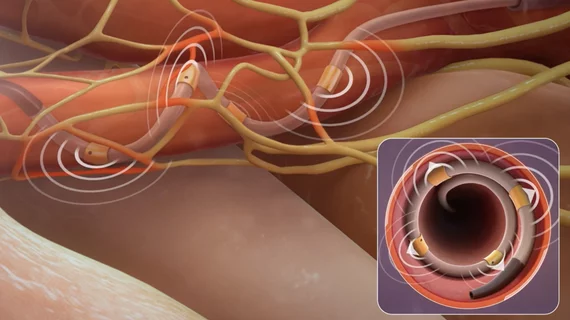
Medtronic’s Symplicity Spyral renal denervation (RDN) system for resistant hypertension has received an approval for reimbursement from Japan’s Ministry of Health, Labour and Welfare.
Hypertension remains a critical problem in Japan—it affects an estimated 43 million adults in the country—and this update should significantly improve patient access to Medtronic’s radiofrequency-based RDN technology.
“This decision enables broader access to a therapy that has been shown to provide sustained reductions in blood pressure and improve outcomes for patients with hypertension,” Jason Weidman, senior vice president and president of the coronary and RDN business at Medtronic, said in a statement. “We are proud to continue our 50-year legacy of serving patients in Japan through innovation and collaboration.”
The Symplicity Spyral RDN system uses radiofrequency pulses to target a patient’s renal arteries. It is a minimally invasive procedure that involves the placement and removal of a single catheter under sedation.

Symplicity Spyral image courtesy of Medtronic.
The system is commercially available in nearly 80 countries around the world. It was approved in Japan in September 2025.
“As hypertension continues to pose a growing health challenge in Japan, the demand for advanced and alternative treatment options is becoming increasingly critical, especially for Japan’s aging population,” Weidman said at the time.
In the United States, the technology secured U.S. Food and Drug Administration (FDA) approval in November 2023. It was the second RDN system the FDA approved for the treatment of hypertension.
One sign of this technology’s continued rise is the fact that the U.S. Centers for Medicare and Medicaid Services approved Medicare coverage on a national level for the use of RDN to treat uncontrolled hypertension in October 2025. Before that, it was only approved on a case-by-case basis.
When the American College of Cardiology and American Heart Association published new hypertension guidelines in 2025, the groups pointed to RDN as an increasingly important treatment option. In fact, RDN received a class IIb recommendation for patients who have already been evaluated by a multidisciplinary team.

Michael has more than 19 years of experience as a professional writer and editor. He has written at length about cardiology, radiology, artificial intelligence and other key healthcare topics.