
CVRx highlights revenue growth in Q4, increased momentum going forward

CVRx, the Minnesota-based medtech company behind the implantable Barostim device for heart failure, reported $16 million in revenue for the fourth quarter of 2025. That represents a 4% from the previous year.
Total revenue for all of 2025, meanwhile, was $56.7 million, up 10% from 2024. In addition, the number of active implanting centers in the United States climbed to 252 in 2025, up from 223 in 2024.
“We achieved key foundational goals in 2025, and we're heading into 2026 with increasing momentum,” Kevin Hykes, president and CEO of CVRx, said in a statement. “Our sales team is building experience and becoming more effective, and we're seeing strong support at high-potential centers.”
One example of that momentum is the new Category 1 CPT codes the Barostim device received from the American Medical Association in 2024. Those codes went into effect on Jan. 1, 2026.
Also, CVRx recently announced a new clinical trial, BENEFIT-HF, focused on the long-term impact on all-cause mortality and heart failure decompensation events. The trial will enroll about 2,500 patients in the United States and Germany, randomizing them to Barostim therapy or a placebo. BENEFIT-HF, if the results are positive, could pave the way for many more patients to be eligible for Barostim therapy than ever before.
“We’re confident that these developments will support our accelerated growth and make Barostim therapy more accessible for heart failure patients in the coming year,” Hykes said.
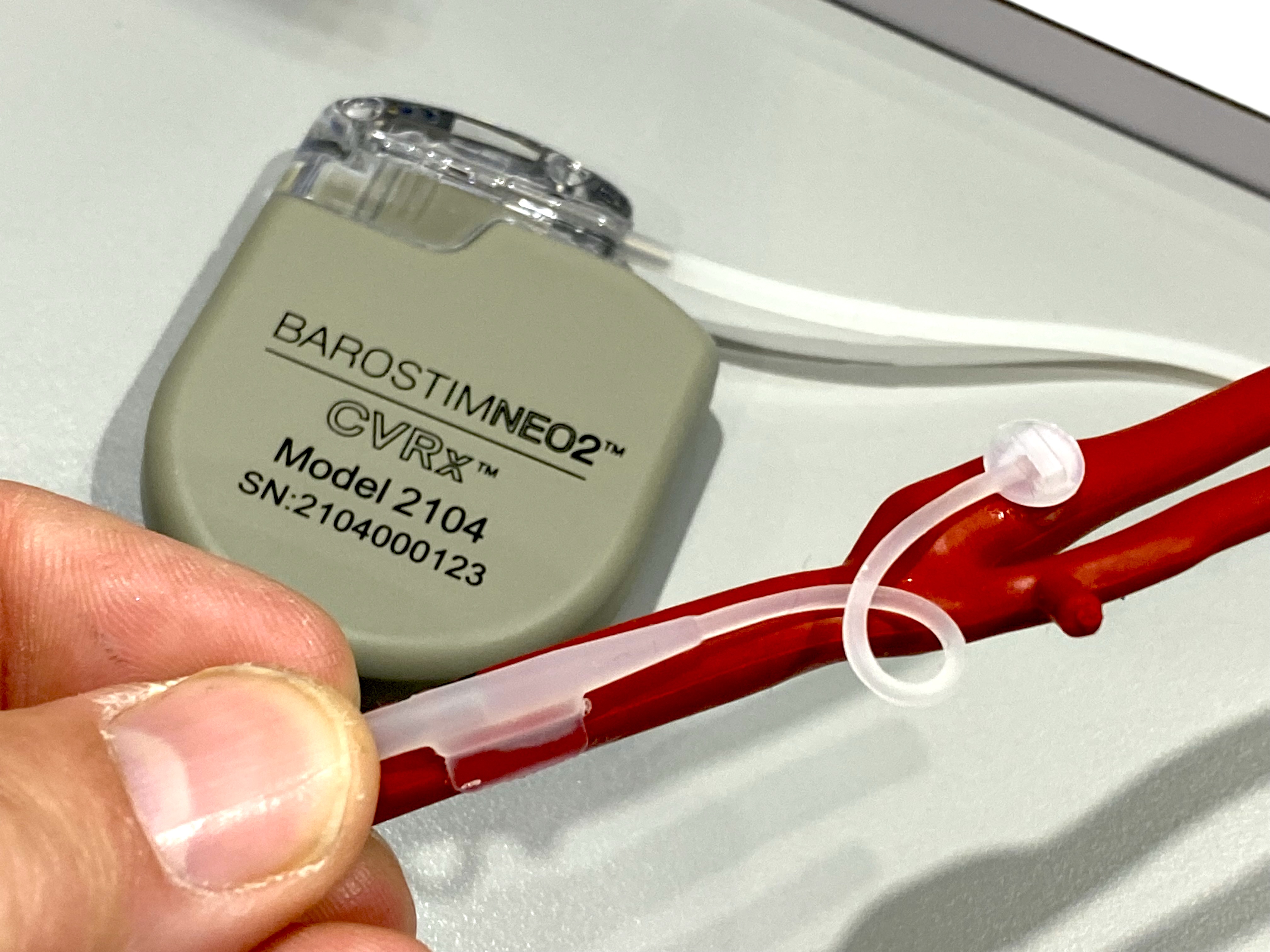
The Barostim Neo 2 CVRx heart failure nerve stimulator on display at Heart Rhythm 2023.
What is the implantable Barostim device?
The Barostim device has received both U.S. Food and Drug Administration and CE mark approval. It works by sending small electrical pulses to sensors in the neck that then send signals to the brain to help regulate the heart, kidneys and vascular system. Those signals to the brain are sent naturally in most patients, but that function is diminished in individuals with heart failure.
Patients who already have a defibrillator are eligible to receive a Barostim device. In fact, many Barostim patients already have a defibrillator.

Michael has more than 19 years of experience as a professional writer and editor. He has written at length about cardiology, radiology, artificial intelligence and other key healthcare topics.