Robotic aortic valve replacement (RAVR) image courtesy of WVU School of Medicine.
It's early for RAVR, but the minimally invasive technique has already started gaining momentum as an alternative to both SAVR and TAVR. We spoke to Vinay Badhwar, MD, one of the world’s leading voices in robotic heart surgery, to learn more.
As more high-risk patients undergo PCI, what is the best antiplatelet strategy following an initial event-free period of DAPT? Does it change after complex PCI? Researchers aimed to answer these questions, and many others, with new findings published in JAMA Cardiology.
Lawrence Wei, MD, assists Vinay Badhwar, MD, during a robotics-guided cardiac surgery. Image courtesy of WVU Medicine.
The entire robotic procedure was performed through one small incision. Surgeons originally recommended the 73-year-old patient undergo open-heart surgery, but she requested a less invasive alternative.
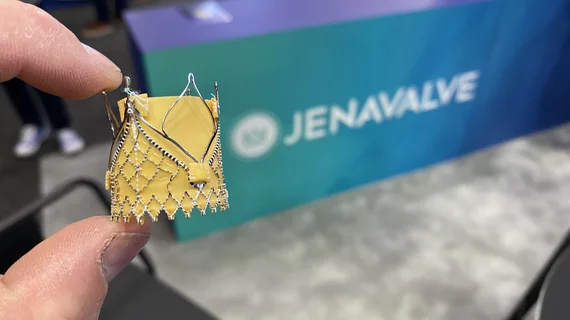
The JenaValve Transcatheter Heart System on display at TCT 2023. Photo by Dave Fornell.
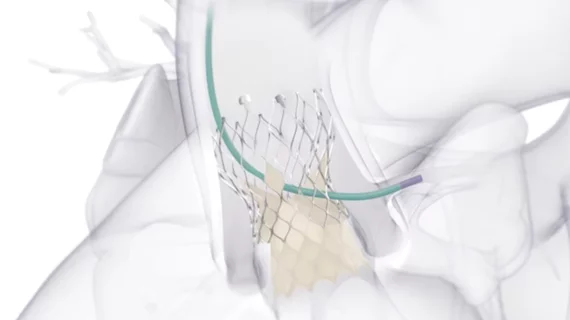
Targeting aortic regurgitation with TAVR valves built to treat aortic stenosis may be the only option a cardiologist has—but valves designed specifically to treat AR are linked to much better outcomes, according to a new meta-analysis. Edwards Lifesciences recently acquired the two companies at the center of this study, JenaValve and JC Medical.
The Evolut Pro TAVR valve. Image courtesy of Medtronic.
One study presented during the three-day conference focused on the potential benefits of an optimized TAVR pathway. Another study, meanwhile, tracked changes in paravalvular leak severity over time.
Intravascular lithotripsy in action. Image courtesy of Shockwave Medical, a part of Johnson & Johnson MedTech.
Intravascular lithotripsy is still a safe and effective frontline preparation tool when PCI patients present with calcified nodules, a new two-year study confirmed. Researchers focused on stent expansion and luminal gain, among other key data points.
The Mediterranean diet, named after the traditional eating habits of Greece and Italy, was once again linked to multiple cardiovascular benefits. The focus of this latest meta-analysis was adults over the age of 60.
PPM is still relatively common after TAVR, especially among patients with a small aortic annulus. What can be done to minimize the risk of PPM? Does valve type play a role? Researchers explored those questions, and many others.
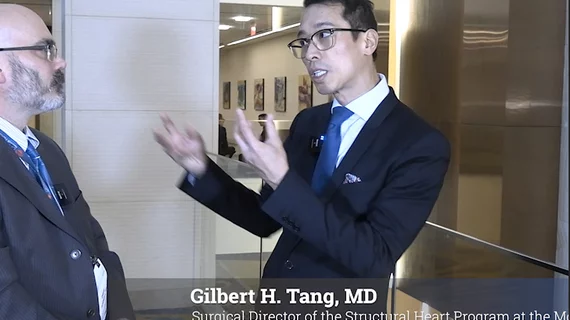
Gilbert Tang, MD, surgical director of the structural heart program at the Mount Sinai Health System, discussed a key challenge care teams often encounter during tricuspid valve procedures.




![The use of intravascular lithotripsy (IVL) during percutaneous coronary intervention (PCI) is still safe and effective when patients present with calcified nodules (CNs), according to new long-term data published in EuroIntervention.[1] Researchers compared outcomes from patients with and without CNs, highlighting key similarities in stent expansion and luminal gain.](/sites/default/files/styles/top_stories/public/2024-12/screenshot_2024-12-02_at_11.07.21_am.png.webp?itok=YDi6SyF_)